 Josef BenešConstruction Manager with 20+ Years of Experience
A good construction diary entry doesn't have to be long. It needs to be specific.
It should help you understand who was working on site, what conditions were like, what work was completed and whether anything important happened during the day.
The biggest mistake isn't writing a short entry. It's writing something so vague that, three months later, all you can tell is that "work continued".
Whether you're managing your own home build or keeping track of contractors, a clear daily construction log can save you a lot of time and uncertainty later.
What Should a Daily Construction Diary Entry Include?
A useful daily site log should give someone who wasn't there a clear picture of what happened.
Depending on the project, it may include:
- Date and project details: When and where the work took place
- Weather and site conditions: Conditions that may have affected construction
- People on site: Contractors, trades and teams involved
- Work completed: Specific activities, locations and progress
- Materials and deliveries: Important materials received or used
- Equipment: Significant machinery or equipment used, where relevant
- Changes and decisions: Adjustments to plans, specifications or agreed work
- Inspections and issues: Checks, problems and actions taken
- Photographs: Visual evidence of work and important construction details
You don't necessarily need to fill in every category every day.
The level of detail should reflect the work being carried out and the purpose of the record.
Important: Construction diary requirements vary between countries and regions. Some projects may require official daily records with specific information, signatures or retention periods. Always check the regulations, permit conditions and contractual requirements that apply to your project.
Construction Diary Example: A Completed Daily Entry
Instead of writing:
Construction work continued.
Try something more useful.
Example daily construction log
Project: Residential House Construction
Date: 18 August 2026
Weather: Clear, approximately 24°C
People on site: Three masonry workers
Work completed: Internal partition walls completed on the ground floor according to the approved drawings.
Materials delivered: Six pallets of masonry blocks.
Changes: Door opening position in the utility room adjusted following discussion with the project designer. Updated location to be reflected in the project documentation.
Photographs: Completed masonry and lintel installation photographed before subsequent finishing work.
Next steps: Review completed work and arrange any necessary checks before the next construction stage.
This entry is still relatively short.
But it tells you what was completed, who was present, what materials arrived and which changes were made.
If a question comes up several months later, you have a much better starting point than a general note saying that construction was progressing.
This is an illustrative example, not a universal official construction diary template. Additional information may be required depending on your location and project.
What to Write When Nothing Unusual Happens
A construction diary isn't only for recording problems.
Most construction days are fairly routine, and that's exactly why regular entries matter.
If insulation was installed, record which part of the building was covered and how far the work progressed.
If electricians continued installing wiring, mention the rooms or areas involved.
If concrete was poured, identify the structural element and record relevant conditions, inspections or supporting documents.
The more specific your description, the less important the overall length becomes.
Compare these two examples:
Electrical work continued.
And:
Electrical wiring installed in the kitchen and utility room. Cable routes photographed before wall finishing. Installation remains subject to the required checks.
The second entry provides information you can actually use later.
How to Record Changes and Decisions
Some of the most valuable information in a construction diary concerns changes made during construction.
A project may originally specify one solution, but practical conditions on site lead to a different approach.
Perhaps a material is replaced, a doorway is moved, a pipe follows a different route or completed work needs to be adjusted.
Changes are a normal part of construction.
The problem arises when an important decision is made during a phone call or informal conversation and nobody records what was agreed.
For significant changes, try to document:
- What changed
- Where the change applies
- Why it was necessary
- Who proposed or approved it, where relevant
- Whether updated drawings or other documents are available
- Whether the change affects cost, schedule or subsequent work
Keep the supporting information connected to the relevant project or daily entry.
A construction diary can help preserve the history of a decision, but it does not replace any formal approval or change-control process required for the project.
Photographs Are Useful, but They Need Context
Photographing reinforcement, electrical wiring, plumbing or waterproofing before it becomes hidden is a valuable habit.
However, a photograph on its own may not tell you where it was taken, why it matters or what it was intended to document.
A close-up of a pipe connection might be perfectly clear today.
Six months later, you may struggle to identify which room or wall it belongs to.
For important construction details, take a wider photograph showing the location and a closer photograph showing the specific work.
Then connect the images to the relevant date, project area or construction diary entry.
You don't need to describe every visible detail in writing. A short explanation combined with clear photographs is often much more useful.
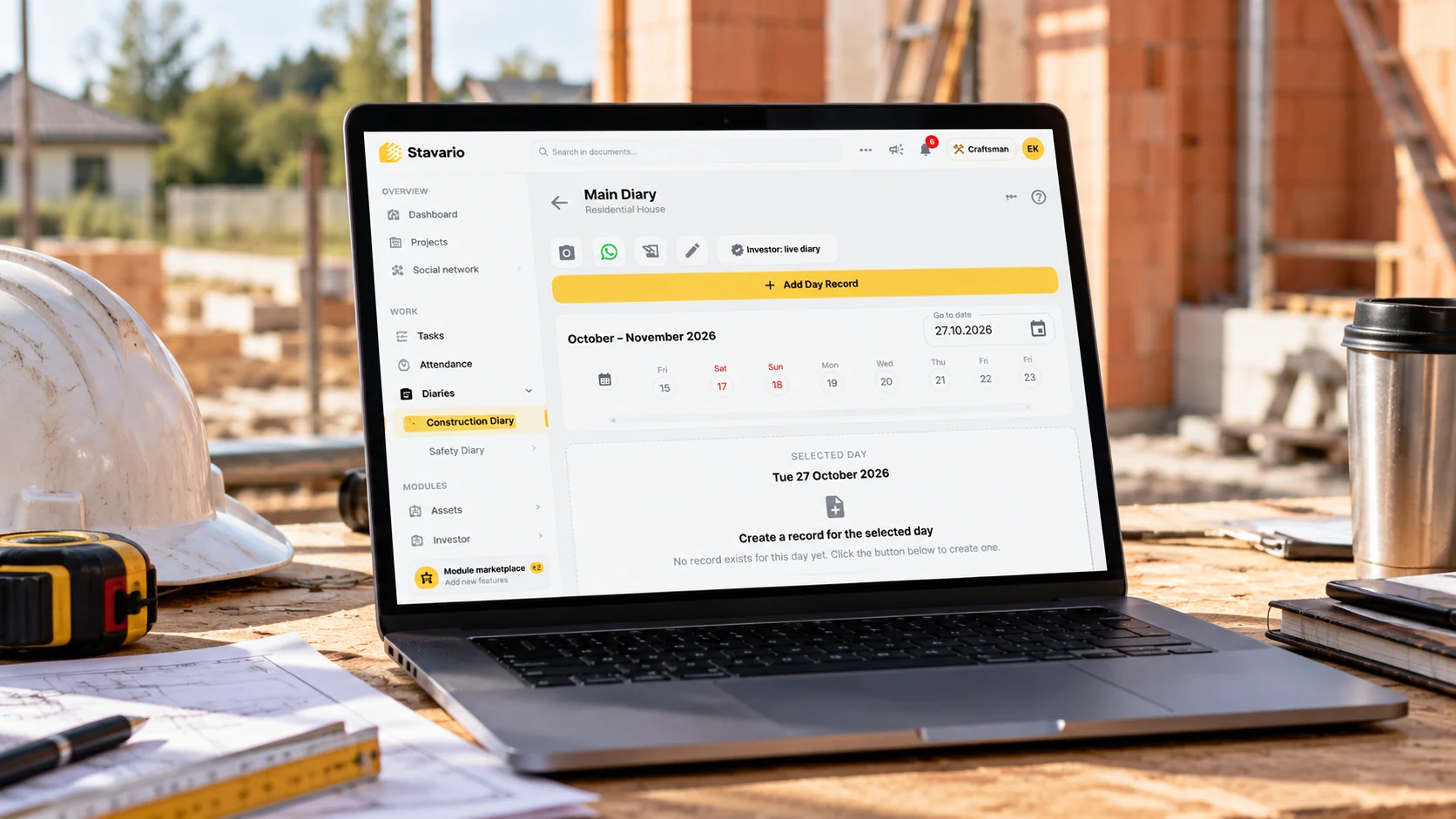
In Stavario, photographs can be stored alongside other information related to the construction project.
Depending on the available AI features, photographs and existing project information may also help prepare a draft diary entry.
The final record should always be reviewed to ensure it accurately describes what happened on site.
Photographs support construction documentation, but they do not replace professional inspections, test results or other required records.
Should You Include the Weather?
Weather isn't just background information.
For certain construction activities, conditions can directly affect how work is carried out.
Temperature, rain, frost, strong winds or excessive heat may be relevant to activities such as concrete placement, roofing, waterproofing or external finishing.
You don't need a detailed weather report for every entry.
Focus on conditions that are relevant to the work and the site.
For example:
Light rain during the morning. External waterproofing work postponed until conditions improved.
This tells you much more than simply recording "Rainy".
If your digital construction diary supports automatic weather information, it may reduce the amount of data you need to enter manually.
Always check automatically added information when it is important to the record.
How Long Should a Construction Diary Entry Be?
There is no universal ideal length.
On a routine day, a few clear sentences may be enough for your personal project records.
On another day, you may need more detail because an inspection took place, an important decision was made or a technical issue affected progress.
Instead of counting words, ask yourself:
If I opened this entry a year from now, would I understand what happened without relying on my memory?
If the answer is yes, the entry is probably serving its practical purpose.
Where official record-keeping requirements apply, the content and level of detail must also meet those requirements.
What Should You Avoid Writing?
A construction diary should be a factual record, not a collection of personal frustrations or vague comments.
Avoid entries such as:
- "The contractors did a bad job again."
- "Everything OK."
- "Problem sorted out."
- "Discussed with the electrician."
These statements don't explain what actually happened.
If something went wrong, describe the specific issue.
For example:
Water leakage observed near the bathroom pipe connection. Plumbing contractor informed. Repair scheduled before wall finishing.
If an agreement was reached, record what was agreed and what should happen next.
Clear, objective descriptions are easier to understand and more useful if questions arise later.
Keep Your Construction Diary Up to Date
One of the most time-consuming parts of construction documentation is trying to recreate entries days or weeks after the work happened.
You start searching for delivery dates, checking old messages and comparing photographs to work out when a particular installation was completed.
Was the concrete delivered on Tuesday or Thursday?
Did the electrician finish before the plumbing contractor arrived?
Was the design change agreed before or after the work started?
These questions are much easier to answer when the information is recorded while it's still fresh.
For practical project management, making a short entry at the end of each working day is a good habit.
If official construction records are required, check whether local rules or your contract specify when entries must be completed.
A short, accurate record made promptly is usually more useful than a detailed account reconstructed from memory several weeks later.
How Stavario Can Help with Daily Construction Records
Keeping a construction diary becomes easier when the information you need is already connected to your project.
With Stavario, you can organise daily construction records, photographs and relevant project information in one place.
Instead of searching through your phone gallery, email inbox and separate notes, you can work with information associated with the same build.
Depending on the available AI features, existing photographs and other project materials may help prepare a draft daily entry.
This can reduce repetitive manual work, particularly when you have already documented the day's activities.
However, AI should not be treated as a source of facts it cannot verify.
Always review generated entries, correct inaccuracies and add any important information that is missing.
The goal is to make construction documentation more practical, not to create records based on assumptions.
A Good Construction Diary Tells the Story of the Project
A construction diary is more than a collection of dates and short notes.
Over time, it becomes a record of how the building was constructed, which decisions were made and what happened at important stages.
It can help you understand past work, communicate with contractors and find information when questions arise.
The most useful diary isn't necessarily the one with the longest entries.
It's the one that is accurate, consistent and easy to refer back to.
Your Site Photos Are Already There. Start Your Daily Log with What You Know
With Stavario, you can keep photographs, construction records and important project information together.
Depending on the available AI features, existing documentation may also help you prepare a draft daily entry instead of starting from a blank page.
Learn more about Stavario and how it helps you organise your construction project.
Frequently Asked Questions
Related articles
How to Keep a Construction Diary When Building Your Own Home
Keep daily progress, photographs and important decisions with the build.
Read moreWhat to Write in a Construction Diary Every Day
Seven things to record daily, a practical example and a checklist.
Read moreWhat to Photograph During House Construction Before It's Covered Up
Document concealed installations and important construction details.
Read more